Overview
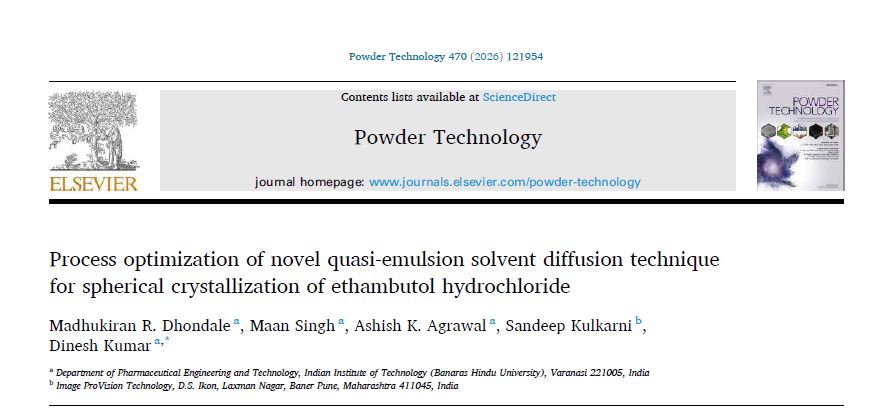
Image ProVision is associated with a recently published peer-reviewed research paper from the Indian Institute of Technology (Banaras Hindu University), Varanasi, published in Powder Technology (Elsevier), a leading international journal in powder and particle science.
The study, titled “Process optimization of novel quasi-emulsion solvent diffusion technique for spherical crystallization of ethambutol hydrochloride”, investigates the improvement of powder flowability and compressibility of a high-dose active pharmaceutical ingredient (API) using spherical crystallization and a Design of Experiments (DoE) approach.
Role of Image ProVision
As part of the experimental characterization, CLAIRITY® image analysis software (Image ProVision Technology, India) was used for microscopy-based particle analysis. The software supported:
-
Measurement of particle size distribution (D10, D50, D90)
-
Calculation of span for size distribution assessment
-
Quantification of circularity of spherical agglomerates
-
Analysis of microscopic images generated during multiple experimental runs
The particle size distribution and circularity data obtained using CLAIRITY® were used along with ImageJ for evaluating the critical quality attributes (CQAs) of the spherical agglomerates.
Supporting Process Optimization
The study demonstrated that circularity, bulk density, and span significantly influence powder flowability, as measured by angle of repose and Carr’s index. Circularity was identified as the most influential factor affecting powder flow behavior.
Image-based measurements contributed to the statistical evaluation of process parameters such as aqueous phase to organic phase ratio, stirring speed, and acetone addition rate, which were optimized using a central composite design (CCD) model.
Research Outcome
The optimized quasi-emulsion solvent diffusion (QESD) process resulted in spherical agglomerates with improved powder flowability while maintaining solid-state integrity and dissolution performance. The study reports good agreement between predicted and experimental values, with a desirability score of 0.88 for the optimized process conditions.
The publication acknowledges the use of CLAIRITY® software for particle size and circularity analysis as part of the experimental methodology.