Comparative Technical Evaluation of Microscopy-Based and Laser Diffraction Particle Size Analysis Systems

Introduction

This is the case study on Comparative Technical Evaluation of Microscopy-Based and Laser Diffraction Particle Size Analysis Systems 

1. Summary

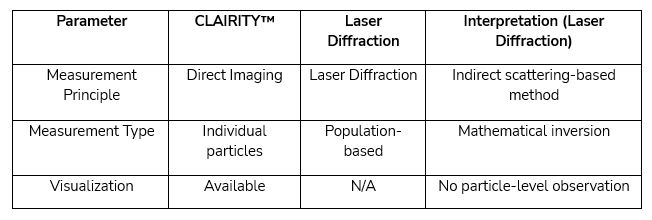
This case study presents a scientific comparison between microscopy-based particle analysis and laser diffraction-based particle sizing techniques. The evaluation highlights fundamental differences in measurement principles, data outputs, and analytical capabilities.

Microscopy-based systems provide direct particle visualization and measurement, enabling morphology-driven characterization. In contrast, laser diffraction systems determine particle size through indirect mathematical interpretation of scattered light, limiting their ability to analyze particle shape and structure.

2. Measurement Principle

2.1 Microscopy-Based Measurement (CLAIRITY™)

  • Direct imaging of individual particles
  • Pixel-based boundary detection
  • Real particle measurement
  • Enables morphology and structural analysis

2.2 Laser Diffraction

Laser diffraction determines particle size by measuring the angular distribution of scattered light when a laser beam passes through a dispersed sample. The size is calculated using scattering models such as Mie or Fraunhofer theory (ISO 13320:2020; Rawle, 2013).

3. Fundamental Scientific Limitation of Laser Diffraction

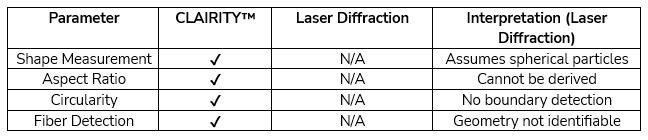
Laser diffraction reports particle size as volume equivalent spherical diameter, which assumes particles are spherical (Xu, 2015; Sequeira, 2018).

It is well established that scattering-based techniques provide size distribution data but lack the ability to capture particle morphology and structural characteristics, which require imaging-based methods (Li et al., 2021; Eshel et al., 2004).

4. Comparative Technical Evaluation

4.1 Measurement Fundamentals

4.2 Morphology & Shape Analysis

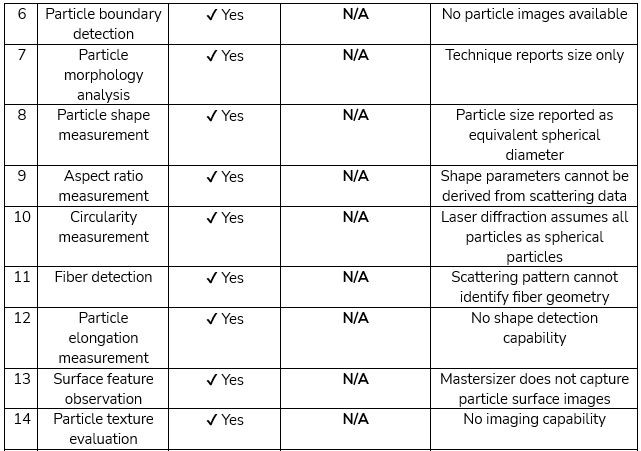
Morphology parameters such as aspect ratio, circularity, and particle geometry cannot be derived from laser diffraction data due to the absence of direct particle imaging (Li et al., 2021).

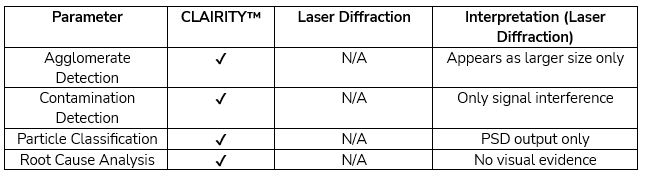
4.3 Advanced Analytical Capabilities

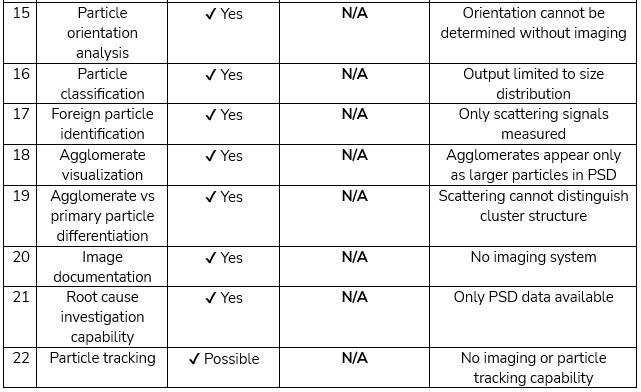
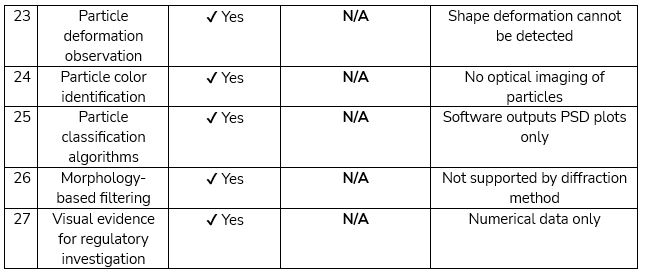
Laser diffraction provides bulk particle size distribution and does not enable particle-level classification or structural differentiation (Eshel et al., 2004).

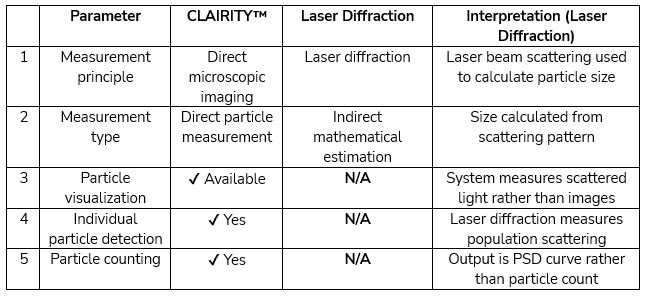
4.4 Data Integrity & Traceability

5. Full Capability Comparison

6. Critical Limitations of Laser Diffraction in Particle Size Analysis

Laser diffraction is a widely adopted technique for particle size measurement due to its speed, reproducibility, and ease of use; however, it is associated with several inherent limitations. The method is based on assumptions such as spherical particle geometry and random orientation, which are often not valid for real-world samples, particularly in pharmaceutical and material science applications.

The technique reports particle size as an equivalent spherical diameter, which may not represent the true dimensions of irregular or anisotropic particles. Additionally, results are highly sensitive to input parameters such as refractive index, and inaccuracies in these values can lead to significant deviations in measured particle size distribution.

Laser diffraction is also prone to bias toward smaller particle sizes due to scattering artifacts and may underrepresent larger particles. As an indirect, model-based technique, it does not provide particle visualization, limiting its ability to assess morphology, shape, or agglomeration. Furthermore, reliance on proprietary data processing algorithms reduces transparency and independent validation.

Although the method offers high precision, its accuracy—especially for non-spherical particles—is often limited, making it less suitable for applications requiring detailed morphological characterization and true particle size determination (Kelly, R. N., & Etzler, F. M.).

7. Conclusion

Microscopy-based particle analysis provides a more reliable and scientifically robust approach by enabling direct visualization and true measurement of individual particles, along with morphology-driven characterization (Li et al., 2021).

This makes it particularly suitable for complex and non-spherical particle systems where accurate particle representation and structural understanding are critical (Eshel et al., 2004; Kelly, R.N.; Etzler, F.M.).

While laser diffraction remains useful for rapid and reproducible bulk particle size analysis, its model-based nature and lack of particle-level insight limit its applicability for detailed and high-accuracy characterization (ISO 13320:2020; Xu, 2015).

Therefore, microscopy-based techniques should be considered the preferred approach for accurate and comprehensive particle characterization.

8. References

  1. ISO 13320:2020. Particle size analysis — Laser diffraction methods. –  Link
  2. Kelly, R.N.; Etzler, F.M. What is Wrong with Laser Diffraction? A Critical Review of Current Laser Diffraction Methods for Particle Size Analysis. Link
  3. Rawle, A. (2013). Basic Principles of Particle Size Analysis. Malvern Instruments. Link
  4. Xu, R. (2015). Particle Characterization: Light Scattering Methods. Springer. Link
  5. Sequeira, C. (2018). Particle Size Analysis by Laser Diffraction. Universidade Nova de Lisboa. Link
  6. Li, M.; Wilkinson, D.; Patchigolla, K. (2021). Image analysis for particle size and shape characterization. Powder Technology. Link
  7. Eshel, G.; Levy, G.J.; Mingelgrin, U.; Singer, M.J. (2004). Critical evaluation of the use of laser diffraction for particle-size distribution analysis. Soil Science Society of America Journal. Link